October 25, 2026
Cancelled for weatherDay 6 of Scotland 2026
Conditions Partly cloudy, 49 to 51°F (felt like 33°F). Wind 30 mph, gusts to 59. Dry.
Cancelled for weather, so we had a gentlemen's day in St Andrews instead.
Panmure Golf Club, founded in 1845, sits in Barry, just west of Carnoustie. It is where Ben Hogan spent two weeks getting used to links golf before winning the 1953 Open at Carnoustie, and the 6th hole is named for him. Our round here on October 25, 2026, day 6 of the Scotland trip, was cancelled for weather.
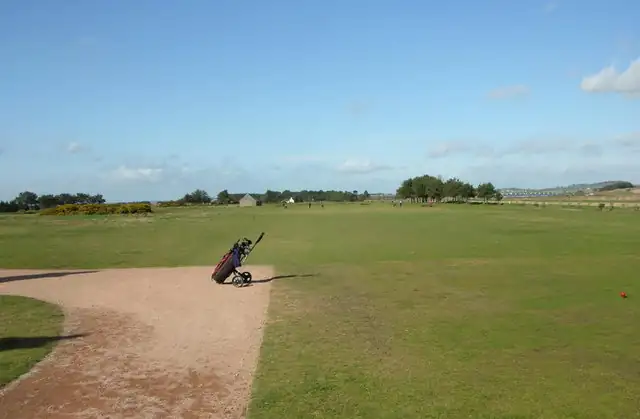
Photo: John McMillan, Wikimedia Commons, CC BY-SA 2.0. Ours go up after we play.
Conditions Partly cloudy, 49 to 51°F (felt like 33°F). Wind 30 mph, gusts to 59. Dry.
Cancelled for weather, so we had a gentlemen's day in St Andrews instead.
October 20 to 27, 2026 · East Lothian, Fife, and Angus · Jake wins 4 to 2. See the whole trip
Golf on Barry Links goes back at least to 1527, when Robert Maule was recorded playing "the gowf" there, with the loser paying for the drinks. Panmure Golf Club itself was formed on May 3, 1845, when seventeen gentlemen met. The club is named for William Maule, first Lord Panmure, and its emblem comes from the Maule family arms. The club describes itself as the 21st oldest golf club in the world.
The first course was at Monifieth. On June 6, 1845, Allan Robertson and Alexander Pirie came from St Andrews and laid out nine holes there for thirty shillings, and the links was extended to 18 holes in 1880. As more clubs crowded onto Monifieth, Panmure bought land at Barry in 1898 from Arthur, 14th Earl of Dalhousie, who later served as captain. A Dundee Advertiser report in 1897 said Old Tom Morris had surveyed and approved the ground, and the club credits Morris with laying out the new course. It was built by R. Duff of Edinburgh, who also built the New Course at St Andrews and Muirfield, and play moved to Barry in 1899.
The layout was refined over the following decades. Colonel J. Lindsay Henderson led a long period of changes from 1923 to 1947, calling the ground "unpromising to the greenkeeper, yet full of promise to the golf architect." James Braid made the most significant changes, though sources date his work differently, and many of the original holes are still in play.
In 1953 Ben Hogan spent two weeks at Panmure preparing for the Open at nearby Carnoustie, the only Open he ever entered. He had already won the Masters and the U.S. Open that year and came early to adjust to links turf and the smaller 1.62-inch British ball, choosing Panmure for its privacy. His caddie, Cecil Timms, was his only companion. Hogan considered the 6th a perfect hole and asked for the pot bunker short and right of the green, which members still call Hogan's Bunker. He won the Open by four shots, closing with a course-record 68.
Panmure has been an Open qualifying venue since 1931, when it shared qualifying with Carnoustie for the first Open held there, and it hosted Regional Qualifying for the 2019 Open. It has also hosted the Amateur Championship twice, the Senior Open, and the R&A Girls' Amateur, and it was one of only 26 clubs that donated toward the Amateur Championship trophy. Long a private club, it now takes visitors, and in 2022 the Ladies Panmure Golf Club, formed in 1927, merged with the men's club into a single club.
Yes. Hogan practised at Panmure for two weeks before winning the 1953 Open at nearby Carnoustie.
Yes, in season (April to October) at set times, booked online.
Founded in 1845; the club has played at its current site in Barry since 1899.
Sources: Panmure: history · Panmure: Hogan at Panmure · Panmure: the course · The Open: inside Panmure · Carnoustie: past Opens · Top 100 Golf Courses: Panmure
Course photos from Wikimedia Commons: Panmure by John McMillan (source, CC BY-SA 2.0).